
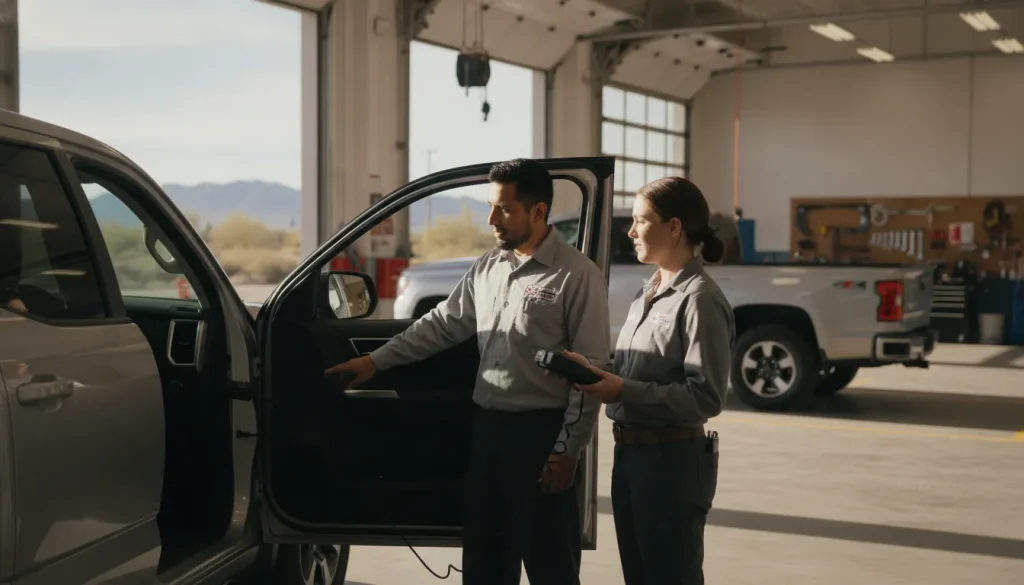
Choosing an ignition interlock provider in Arizona is not only a question of which device fits your vehicle. The installation must support the compliance process, and the service team must be available when calibration, reporting, troubleshooting, transfer, or removal becomes necessary. Those details matter just as much as the breath test itself.
Contact Budget IID about an Arizona ignition interlock installation.
When comparing intoxalock ignition interlock options with Budget IID, focus first on Arizona compliance, court-approved installation, local service coverage, calibration and reporting support, and the provider’s removal process. Then compare daily-use features, including verified options such as Budget IID’s non-recorded test option and straight blow option, without assuming that an unverified competitor difference is universal.
An ignition interlock is a breath-test device connected to a vehicle’s ignition. The vehicle generally will not start when the driver’s BAC is above a preset limit, and running retests help confirm sobriety while driving, according to the CDC. Arizona drivers should also separate device-level behavior from MVD and ADHS program requirements. A provider can install and support the device, but it cannot decide the legal steps required in an individual case.
Start by comparing the practical and compliance questions that affect your entire IID period, not just the first appointment.
What should an Arizona driver compare first?
Start with compliance, not brand recognition. An ignition interlock is a breath-test device connected to your vehicle’s ignition. The vehicle will not start unless your breath test is below the device’s preset limit, which the CDC describes as usually 0.02 g/dL BAC. The CDC explains how ignition interlocks work, including why the device’s operation is separate from the legal requirements in your individual order.
For an Arizona driver, the first question is whether the installation, device, and documentation fit the requirements set by the Arizona MVD and your court. Confirm that the provider can supply a court-approved device, use certified technicians, and provide the records or compliance certificate you need. A provider cannot change your court order, determine your reinstatement requirements, or guarantee an approval, so verify those details with the MVD, court, or your attorney.
Next, compare the practical service model. Ask where installation and calibration can occur, whether local appointments are available in your area. And what support is provided when you have a question about a test, calibration deadline, or vehicle change. Budget IID is headquartered in Phoenix and serves Phoenix, Mesa, Tucson, Goodyear, and Avondale. Its listed services include installation, monitoring, calibration, support, transfer, and removal. Those local options may matter more than a national service-center count if you need help completing an Arizona-specific requirement.
Also compare how the device handles daily operation and reporting. The CDC notes that running retests help ensure drivers remain sober while operating a vehicle. CDC guidance on running retests can help you understand why retest procedures and anti-circumvention features deserve careful attention. Ask how test results and compliance events are documented and reported, and learn the difference between a device event and a later MVD or court decision.
For a broader checklist, use this guide to compare Arizona IID providers. Once those baseline requirements are clear, you can evaluate what is publicly verified about Intoxalock ignition interlock and how it compares with Budget IID’s documented Arizona service model.
What can you verify about Intoxalock ignition interlock?
Public information can help you understand how a provider describes its services, but it cannot answer every question that matters in an Arizona IID case. A company may publish information about its service network, customer support, account tools, or installation process. Those descriptions are useful starting points. They are not, by themselves, proof that a specific installation satisfies your court order or Arizona MVD requirements.
At the device level, an ignition interlock is a breath-test device connected to a vehicle’s ignition. The vehicle is designed not to start when the driver’s breath alcohol measurement is above the applicable preset limit. Many programs also use running, or rolling, retests while the vehicle is in operation. These retests are intended to help ensure the driver remains sober while driving and to reduce circumvention, such as another person providing the initial breath sample. The CDC provides this general explanation of interlock operation, but it does not endorse a particular provider or decide which device is appropriate for an individual case: CDC ignition interlock information.
The important limits are easy to miss. A provider’s website does not determine whether you are eligible for an Arizona license. What your court order requires, how a violation will be handled, or how long your IID period will last. It also cannot establish that another company’s device or service will perform the same way for every driver. Customer reviews and broad marketing statements may reflect individual experiences, but they should not be treated as universal evidence.
Compare documented requirements, not winner claims
A fair comparison focuses on questions you can verify for your own situation:
- Is the provider and installation process accepted for your Arizona requirement?
- Who handles installation, calibration, reporting, transfers, and removal?
- What records or compliance certificates will you receive?
- How will the provider explain failed tests, missed rolling retests, tampering, or missed appointments?
- Can the provider confirm compatibility with your vehicle and service area?
Budget IID describes its offering as court-approved and NHTSA-approved installation, monitoring, calibration, support, transfer, and removal services. It also serves Arizona communities including Phoenix, Mesa, Tucson, Goodyear, and Avondale. Those are service details to verify against your order and agency instructions, not a reason to make a blanket winner claim. Before choosing any provider, compare the documented process, local availability, and compliance support that apply to you.
How do installation and local availability compare?
Installation is one of the most practical dimensions to compare when researching an intoxalock ignition interlock or any other provider. The device must be installed correctly, but the appointment should also leave you prepared to use it and document compliance. Confirm that the provider and installation meet the requirements in your Arizona MVD or court order before scheduling.
What to expect from a Budget IID installation
Budget IID says Arizona installations are completed by certified technicians and generally take one to two hours. That appointment includes hands-on training, so you can learn how to use the device before leaving. As well as a compliance certificate for submission to the MVD or court. You can review more detail about ignition interlock installation time when planning transportation around the appointment.
The one-to-two-hour estimate is typical, not a promise for every vehicle or situation. Installation time can vary based on the vehicle, the appointment details, and any requirements in your order. Same-day installation may be available in many cases, particularly through the Phoenix location, but you should confirm availability rather than assume a same-day appointment is guaranteed.
Local and mobile service in Arizona
Budget IID is headquartered in Phoenix and lists service in Phoenix, Mesa, Tucson, Goodyear, and Avondale. Free mobile installation is available in some Arizona markets, including Phoenix, Mesa, Tucson, and Goodyear, subject to service-area availability. Mobile service can reduce the need to arrange transportation to an installation site, but the exact address, vehicle, and scheduling window still need to be confirmed. It is not a universal service promise, and the availability terms differ by market.
Vehicle compatibility is another question worth asking before you book. Budget IID states that it supports all vehicle types, including hybrids and electric vehicles. Tell the provider your vehicle’s year, make, model, and powertrain in advance so the technician can confirm the correct installation plan. A local provider’s service footprint, mobile options, technician process, training, and documentation may matter more to your decision than a broad national presence. Compare those verified details with the requirements you must satisfy, and ask each provider to explain anything that remains unclear.
How do calibration, reporting, and removal fit Arizona compliance?
The handheld device is only one part of the process. At the device level, an ignition interlock measures breath alcohol, controls whether the vehicle can start, and may request rolling retests while you drive. At the program level, the Arizona MVD, court, or another responsible authority determines what documentation and compliance steps apply to your case. A provider can service and report on the device, but it cannot change your court order.
Calibration keeps the device within its required schedule
Arizona calibration commonly starts with an initial 30-day appointment, followed by visits every 60 to 90 days. Your court order can require more frequent visits, and the stated Arizona maximum interval is 90 days. Confirm the schedule tied to your specific requirement rather than relying on a general appointment reminder. Budget IID describes detachable devices and USB data access as tools that can support calibration and data downloading efficiently. Review common IID calibration questions before your first service visit.
Reports reflect events, not the whole legal decision
The device data logger can record test attempts, including passes, warnings, and failures. In Arizona, reported compliance events can include a failed test, a missed or refused rolling retest, tampering, missed calibration, or unauthorized removal, according to applicable requirements. Those categories should not be treated as interchangeable. A failed test means the device detected alcohol at the applicable threshold. A missed or refused rolling retest means the requested test was not completed. The exact administrative response depends on the governing requirements, so ask the MVD, court, probation authority, or attorney how your order handles each event. For safe, practical guidance on the in-car testing step, see Arizona rolling retest rules.
Arizona standards also call for anti-circumvention features and real-time reporting capability. Random retests serve a safety and integrity purpose by helping reduce the possibility that someone else provides the initial breath sample. Follow the device prompts safely, pull over when appropriate, and never attempt to bypass a test.
Removal is a program step, not a personal preference
Removing an IID because driving feels inconvenient does not by itself complete an Arizona requirement. Removal should be coordinated with the provider after the applicable program or court requirement is complete and any required authorization or documentation is in place. Budget IID provides transfer and removal support when a vehicle changes or a program is completed. Research on interlock programs also cautions that evidence of effectiveness during installation does not establish that program benefits continue after removal. Keep your completion records and confirm the next step with the authority overseeing your case before scheduling removal.
Which device features matter in daily use?
When comparing an intoxalock ignition interlock option with another provider, focus on how the device fits your daily routine and Arizona compliance obligations. A compliant IID measures breath alcohol, uses a preset limit, and may require rolling retests while you drive. Arizona standards also address fuel-cell technology, anti-circumvention features, reporting capability, and certified installation. The CDC explains the basic ignition-interlock function, while Arizona-specific details should be confirmed against your order and the MVD requirements.
The table below identifies practical comparison points without assuming that an unverified competitor difference exists. Public descriptions can change, and a provider’s general feature list does not replace the requirements in your court or MVD paperwork.
| Comparison area | What to verify | Budget IID information |
|---|---|---|
| Arizona approval and compliance process | Confirm that the device and installation satisfy the applicable Arizona requirements, and ask who supplies training and documentation. | Budget IID provides court-approved and NHTSA-approved installation, monitoring, calibration, support, transfer, and removal services. Arizona installation includes certified technicians, hands-on training, and a compliance certificate for MVD or court submission. See the provider overview. |
| Breath sample and retests | Ask about the normal startup sample, rolling-retest process, and instructions for responding safely while the vehicle is moving. | Budget IID devices monitor breath alcohol and conduct rolling retests. Rolling retests are intended to help ensure sobriety during operation, and random retests also help reduce circumvention risk. Review the CDC’s explanation of retests. |
| Event reporting | Understand which events are recorded, who receives reports, and how a voluntary self-check differs from a compliance test. | Budget IID reports applicable compliance events to the court or Arizona MVD. A recorded compliance event is distinct from a voluntary non-recorded self-check, which is not submitted as a driving event. |
| Installation support | Check vehicle compatibility, appointment options, calibration access, and support after installation. | Budget IID supports all vehicle types, including hybrids and electric vehicles. Its devices are designed for practical service access, including detachable-device and USB data-access support. |
| User-facing device options | Ask whether optional functions make routine safety checks or breath sampling easier, and request clear operating instructions. | Budget IID offers a non-recorded test option that functions as a standalone breathalyzer. It also offers a straight blow option for non-circumvention rather than traditional suck-back-and-blow operation. |
These features matter because the best device is not just one that starts the vehicle. It should support accurate daily use, understandable reporting, and the specific compliance process you must complete. Ask the provider to explain any feature in writing before installation, then compare that explanation with your Arizona order.
What should you ask before choosing an Arizona IID provider?
A short conversation before installation can prevent confusion later. Ask the provider to answer each question in writing, then compare the answers with your Arizona MVD or court requirements. The goal is not to choose based on a brand name alone. It is to confirm that the device, technician, appointment, reporting process, and ongoing support fit your specific compliance order.
- Is the device approved for my Arizona requirement? Ask whether the device meets the applicable Arizona standards, including the required set point, fuel-cell technology, anti-circumvention features, and reporting capability. Also ask whether the installer is certified. Budget IID describes its devices as court-approved and NHTSA-approved, with certified technician installation.
- Where and when can installation happen? Confirm the exact installation location, available service areas, appointment length, and whether mobile installation is available for your address. Arizona installation generally takes one to two hours and includes hands-on training plus a compliance certificate for MVD or court submission. Same-day appointments may be available in some cases, but timing depends on availability.
- What is the calibration schedule? Ask when the first calibration is due, how future appointments are scheduled, and what happens if a court order requires more frequent visits. Arizona schedules commonly include an initial 30-day calibration followed by visits every 60 to 90 days, while Arizona rules set a 90-day maximum interval.
- Which events are reported, and who receives the reports? Get a clear explanation of how failed tests, missed or refused rolling retests, tampering, missed calibration, and unauthorized removal are handled. Ask whether results go to the court, Arizona MVD, or another required authority. The provider reports device events, but the MVD, court, or probation authority determines the program-level consequences.
- How are vehicle changes, removal, and transfers handled? Ask what documentation is needed when you change vehicles or complete the program, and who authorizes removal. A provider should explain its transfer and removal process rather than leaving you to guess about the next step.
- Will the device work with my vehicle and support needs? Provide the year, make, model, hybrid or electric drivetrain, and whether the vehicle has a push-button or keyless ignition. Budget IID supports hybrids and electric vehicles. Review details about an IID for push-button cars if that applies to you. Finally, ask how to reach support, what training is included, and whether you will receive an itemized written explanation of service and compliance requirements. For a separate overview of Arizona ignition interlock costs, review the cost guide without relying on verbal estimates.
Contact Budget IID to discuss your Arizona IID installation and next steps.
Frequently Asked Questions
What is an intoxalock ignition interlock?
An intoxalock ignition interlock is a breath-test device connected to a vehicle’s ignition. You must provide a breath sample before starting, and the vehicle will not start when the measured BAC is above the device’s preset limit. Depending on the program, the device may also require rolling retests while you drive. The CDC explains how ignition interlocks work.
How should I choose an Arizona ignition interlock provider?
Start with Arizona approval, certified installation, local service coverage, calibration scheduling, reporting procedures, and removal support. Ask how the provider handles training, compliance documentation, vehicle transfers, and service for your specific vehicle. A local provider may also offer mobile installation in selected areas, but availability should be confirmed before you schedule.
What should I ask about calibration and compliance reporting?
Ask when your initial calibration is due, how often later calibrations occur, and how the provider reports failed tests, missed or refused rolling retests, tampering, and missed calibration. In Arizona, calibration commonly begins at 30 days and then occurs every 60 to 90 days, while the maximum interval is 90 days. Your court order may require more frequent visits.
Can I drink one beer with an ignition interlock installed?
No amount of alcohol should be treated as safe before driving with an interlock. The device measures alcohol on your breath and can prevent the vehicle from starting when the reading exceeds its set point. Alcohol can also remain in your system longer than expected. If you have been drinking, use another transportation option instead of testing your limit.
Does Budget IID offer features beyond basic breath testing?
Budget IID identifies two verified device differentiators: a non-recorded test option that functions as a standalone breathalyzer, and a straight blow option designed for non-circumvention. These features should be evaluated alongside Arizona approval, installation, calibration, reporting, vehicle compatibility, and removal support. Do not assume another provider lacks a feature unless that provider confirms it directly.
Get started with your Arizona IID questions
Choosing an ignition interlock provider involves more than comparing device names. You may want to confirm installation requirements, calibration and reporting support, removal steps, and which service options fit your location and vehicle. Budget IID can help you discuss an Arizona-compliant installation and identify the next steps for your situation. Contact the team with your questions so you can make an informed decision based on the requirements that apply to you. Contact Budget IID to discuss your Arizona IID installation.