
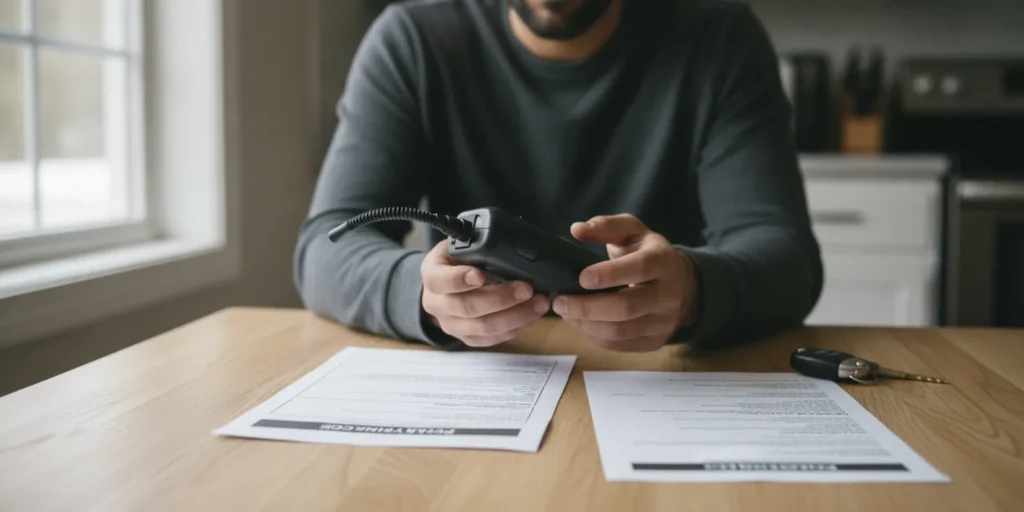
If you received an ignition interlock extension notice and believe it is based on an error, the Arizona ignition interlock violation extension appeal process begins with a careful review of the notice and the underlying event records. First identify who issued the notice, what event it names, and what action it says will happen. Arizona drivers should not assume a device issue and an MVD program decision are the same thing, or assume that a particular appeal form or deadline applies to every case.
Contact Budget IID to discuss your IID records
What does an IID extension notice mean?
An extension generally means that an interlock requirement may continue beyond the date a driver expected. The notice should identify the reason or event associated with the action, but the wording can be difficult to interpret. Start by reading the complete notice, including any page that explains how to respond. Record the date you received it and keep the envelope or electronic delivery information if available.
Separate three questions that can otherwise get mixed together:
- What did the device record? This is the event or test information recorded by the IID.
- What did the provider report? The provider may transmit device information as part of program monitoring.
- What has the state decided? The Arizona MVD or another responsible agency determines program-level consequences and required next steps.
A disputed device reading does not automatically mean the state has changed its decision. Likewise, an extension notice is not the same thing as a device lockout or an on-road warning. For a general overview of the state process, review Budget IID’s Arizona DUI program information and the agency’s Arizona MVD ignition interlock FAQ.
Is there a formal appeal for an Arizona IID extension?
Do not assume there is a standard court-style appeal or that a particular deadline applies to every extension. The Arizona MVD FAQ says there is no formal appeal process for extensions based on interlock violations, while describing a review of cases before extension letters are issued. That is an important distinction: a driver may be able to raise a factual concern or ask for an explanation, but that does not establish a right to a formal appeal or guarantee that an extension will be withdrawn.
Read the current agency guidance and any notice you received. The MVD FAQ also warns that a violation may be reported and an interlock requirement could be extended. For additional context on how interlock information is used, the National Highway Traffic Safety Administration’s report on interlock data utilization discusses review and extension decisions. It is background material, not a substitute for current Arizona instructions or an individual determination.
If the notice mentions a suspension, reinstatement hearing, or a separate administrative action, treat that as a distinct issue and ask the MVD which process applies. The existence of one kind of hearing does not necessarily create an appeal route for a different extension decision. Confirm any response method and deadline with the agency promptly rather than relying on an online article or a provider’s interpretation.
When you contact the MVD, describe the notice as it is written rather than using a legal label you are unsure about. Ask which agency action is pending, whether the extension has already been added to your record, and whether any separate license status or hearing issue exists. These are different questions. Write down the answers and the office or contact channel that provided them. If a representative directs you to another unit, ask for the unit name and the correct way to reach it so you do not send records to the wrong place.
How can you check whether the reported event is accurate?
Before disputing an extension, build a simple timeline. Gather the notice and compare it with the IID information and your own records. You are looking for a specific mismatch, not merely a general belief that the decision feels unfair.
- Copy the notice details. Write down the date, case or reference number, named event, reporting period, and any instructions about contacting the MVD.
- Request or locate your device records. Ask your provider how to obtain the relevant event information or report. Identify the date and time range that matches the notice. Keep the report in its original form.
- Check your calendar and vehicle use. Note who had access to the vehicle, whether it was driven, and whether a service appointment, calibration, or other event occurred around the stated time. Stick to facts you can support.
- Look for concrete discrepancies. Examples include a date that does not match the report, an event attributed to a period when the vehicle was being serviced, or a notice that appears to describe a different type of event than the record shows.
- Make a copy of every item. Keep the notice, records, appointment confirmations, service documents, and your written timeline together. Do not alter or annotate the originals.
For example, suppose the notice identifies an event on Tuesday, but the device report you received shows that entry on Wednesday. Do not simply write that the agency is wrong. Note both dates, identify the report page or entry, and ask the MVD to confirm which event and time it relied on. If the vehicle was at a service appointment around that time, attach the appointment record and explain the connection without assuming that service itself proves an IID event could not have occurred.
Use a consistent method when comparing timestamps. Check whether the notice gives a date only or a date and time, and make sure you are comparing the same reporting period and event identifier. If a record uses a code you do not understand, ask the provider to explain the device terminology; then ask the MVD whether that code is the event behind the extension. Keep the original wording in your notes so that a paraphrase does not accidentally change what the record says.
Some event labels can sound similar but refer to different circumstances. Arizona drivers should understand the difference between a missed rolling retest, when no test is completed within the retest window, and a failed rolling retest, when a test detects alcohol. Under Arizona ADHS rules, these can have different program consequences: a missed retest can add one month to the IID period per occurrence, while a failed retest can trigger immediate suspension and a reinstatement hearing. Do not infer which event occurred from a brief label alone; ask what the record says and confirm the consequence with the agency.
For device operation questions, Budget IID’s Arizona guide to using a car breathalyzer may help explain ordinary use. If the issue is a calibration or service date, see the Arizona IID calibration information. These resources explain device and service topics; they do not decide an MVD dispute.
What should you include in a request for review?
Keep your request organized and factual. The goal is to help the recipient identify the record and understand the exact discrepancy. Do not make claims you cannot verify, and do not send original documents unless the agency specifically requires them.
- Your full name and the identifying details requested on the notice.
- The notice date and the extension or event you are asking about.
- A short timeline with dates and times, including the event as listed in the record.
- The specific item you believe is inaccurate or unclear.
- Copies of relevant supporting records, labeled so the reader can follow them.
- A clear question or requested action, such as asking the agency to explain the event code, confirm the review status, or tell you how to submit additional evidence.
A useful opening might be: “I am requesting clarification and review of the IID event listed on [date] in the notice dated [date]. The attached record appears to show [specific discrepancy]. Please confirm the event being relied on and tell me whether any additional information or action is required.” Adapt it to your actual facts and the notice instructions. A request for review is not a promise of reversal.
Make the attachments easy to match to the request. Give each copy a short label such as “notice,” “device report,” or “service appointment record,” and refer to that label in the timeline. If several records use different dates or time formats, state exactly what each document shows instead of silently reconciling them. Keep a separate copy of the complete packet in the same order you submitted it. This makes a later follow-up more precise if the MVD asks for a particular page or event detail.
Use the contact channel given by the MVD or on the notice. Keep a copy of what you send, note the date and method, and save any confirmation number or reply. If you speak with someone by phone, write down the date, the office contacted, and the instructions given. Ask how to follow up if you do not receive a response.
What is the difference between a device issue and an MVD decision?
The distinction matters because different questions go to different parties. A provider can help explain how to obtain or interpret device-related records and can address service questions. The MVD is the state agency to contact about the status of a driver requirement, an extension notice, a suspension, or required reinstatement steps. A provider cannot promise an agency decision or change a state record simply because a driver disputes an event.
| Question | Device or provider level | MVD or program level |
|---|---|---|
| What happened on the date in question? | Ask how to obtain the IID event record and clarify device terminology. | Ask which event the agency relied on and whether it is tied to the notice. |
| Is the record incomplete or confusing? | Ask the provider to explain the record, reporting period, or service history. | Ask the MVD how to submit a correction or supporting documentation. |
| Has an extension or suspension been imposed? | A provider can explain device service information but does not determine the state requirement. | Confirm the current license and IID status, reason, instructions, and any response deadline. |
| What should happen next? | Confirm device service or calibration needs and keep the appointment records. | Follow the agency’s written instructions for review, hearings, reinstatement, or program completion. |
For a broader description of how reporting works, consult Budget IID’s Arizona reporting information and its Arizona DOT FAQs. For questions about an individual requirement, the notice and direct MVD guidance control.
How should you follow up on a review request?
A submitted request does not necessarily change the date or requirement shown on a notice. After sending your information, keep track of whether the agency confirms receipt and whether it asks for anything else. If you do not receive confirmation, use the contact method on the notice to ask whether the request reached the right office. Give the date you sent it and the case or reference number, but do not resend sensitive documents through an unverified channel.
When you receive a response, read it carefully for the decision, the reason, and any action you still need to take. If a statement is unclear, ask a focused follow-up question. For example, you can ask whether the event record was reviewed, what date the agency is using to calculate the requirement, or which office handles a separate reinstatement question. Keep the answer with your original notice and request.
If the agency says the extension remains in place, ask what the current completion requirements are and how you can confirm your status. Avoid treating a provider service visit as confirmation that a state requirement has ended. Likewise, do not assume that a device report, a verbal explanation, or a pending review changes your license status. Get the applicable status and next steps directly from the MVD, preferably in writing when available.
A practical follow-up log can be brief: record when you sent the request, how you sent it, any confirmation or reference number, the date of each conversation, and what the agency said you should do. If the response refers to a separate process, note that process name and ask where its instructions can be obtained. Keep copies rather than relying on memory, especially if you have to make more than one call or submit additional documentation later.
What should you do while the question is being reviewed?
Do not stop following the requirements that are currently in effect just because you have asked for review. Continue to use and maintain the IID as instructed, keep required appointments, and follow any agency directions unless the MVD confirms a change. If you are unsure whether a requirement is still active, verify your status with the agency before acting.
A pending question and an active requirement can exist at the same time. For instance, you may be waiting for clarification about one reported event while still being responsible for a calibration appointment or other IID instruction. Keep those matters separate: meet current obligations, preserve proof that you did so, and pursue the record question through the MVD’s specified channel. If agency guidance changes, save the updated instruction and note when it took effect.
Avoid trying to bypass, disconnect, or tamper with the device. Those actions can create a separate problem and will not resolve a disagreement about an earlier record. If a device appears to malfunction, contact the provider using its support instructions and preserve any service documentation. Budget IID’s guide to an IID lockout covers a device-level situation; it is different from disputing an extension decision.
Drivers should also check that the installation and program arrangement meet Arizona requirements. An out-of-state IID installation does not satisfy Arizona IID requirements for an Arizona-licensed driver. If you need help understanding installation or service options, review how to get an interlock device in Arizona or contact a provider. Budget IID serves Arizona and select areas in California, and free mobile installation is available only in some Arizona areas.
Ask Budget IID about obtaining your device records
Frequently asked questions
Can I appeal an Arizona IID extension?
The Arizona MVD FAQ says there is no formal appeal process for extensions based on interlock violations. You can still check the notice, ask the agency to explain the decision, and provide relevant information through the channel it identifies. Do not assume that submitting a question pauses or changes the requirement.
Is there a standard deadline to dispute an extension?
Do not rely on a general deadline from another driver’s case. Check your specific notice and ask the MVD promptly what response timing applies, especially if it mentions a suspension, hearing, or other action. Keep a record of when you contacted the agency.
Can my IID provider remove an extension?
A provider can explain device records and service history, but the state determines the program requirement. Ask the MVD about the extension or status of your driving privilege, and ask your provider for the relevant device information if you need it to explain a factual discrepancy.
What if I disagree with the event shown in the notice?
Request the underlying device information, compare it with the notice, and identify the exact mismatch. Send a concise, dated request with copies of records through the channel specified by the agency. Continue to follow active IID requirements while waiting unless the MVD tells you otherwise.
Get help organizing your IID questions
Keep the focus on the record, the notice, and the agency decision. If you need help understanding how to obtain device information or arrange service, contact Budget IID; for an extension, suspension, or hearing question, confirm the controlling instructions with Arizona MVD.
Talk with Budget IID about your next IID service step
A clear timeline and prompt confirmation from the MVD can help you understand what happened and what you need to do next.